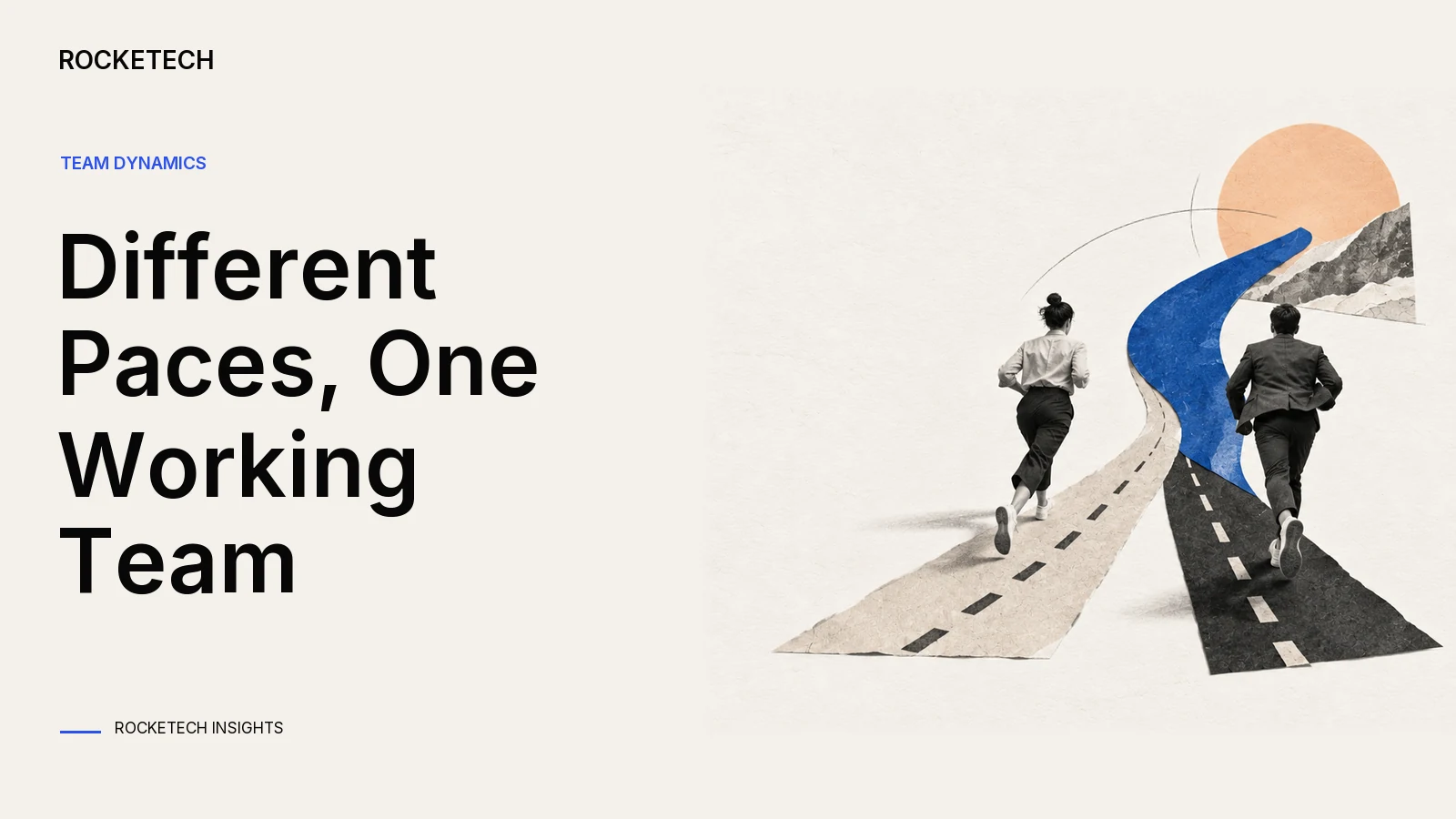
Some people do their best work in bursts: a hard push, a big result, then they need a rest. Others work at a steady pace for months and rarely run out of energy. When this article first ran, Natalia Chistyakova, our Lead Scrum Master, called them sprinters and marathon runners. Most people are a mix.
It is a useful way to talk about pace. It isn’t a validated personality test, and we don’t use it to sort or label people. What matters for a founder or product owner is the other half of the picture: a product build has phases that need bursts and phases that need endurance, and you decide how the team is paced through them.
Pace is a planning decision
A first release in 2-4 weeks is a burst. A product that keeps growing for two years is a long run. Launch week, store review and a production incident are short spikes. If every phase is planned as a sprint, the team burns out. If every phase is planned as a marathon, the first release drags on while the market moves.
The methods we work with say the same. The Agile Manifesto principles say sponsors, developers and users “should be able to maintain a constant pace indefinitely.” The Scrum Guide Expanded, updated in January 2026, says “Working in Sprints at a sustainable pace improves Focus and consistency.” A burst is fine when it ends. The trouble starts when the burst becomes the normal pace.
WHO’s mental health at work fact sheet, updated in September 2026, lists “excessive workloads or work pace, understaffing” among the risks to mental health at work. Much of a team’s pace is set by the plan.
Look at how the team works, not at personality types
If you want data on teams, look at how they work. The 2025 DORA report, based on nearly 5,000 technology professionals, describes seven team profiles built from how teams work and deliver. One, “foundational challenges,” describes teams “trapped in survival mode” with significant gaps in their processes and environment, and high levels of burnout and friction. Another, “harmonious high achievers,” shows positive results for team well-being, product outcomes and delivery.
Those profiles describe process and environment, and a founder can change both through the plan, the scope and the staffing.
Which phases need which pace
Phase
Pace
What helps
Risk
Discovery and first release (2-4 weeks)
A focused burst
A narrow scope, fast decisions, one product owner
Burnout if the burst never ends
Store review and launch
A short spike
Submit early, keep a fix-only window after launch
Late nights when review is left to the last day
Growth (months)
Steady
A fixed sprint length, a backlog ordered every sprint
Drift and slow starts
Production incidents
Short, unplanned
An on-call rota and a written runbook
The same two people get every call
Maintenance and upgrades
Steady, planned
Yearly platform updates in the plan
Updates skipped until an upload fails
Phases of a product build and the pace each one needs
EasySpk, an iPhone voice keyboard, is a burst: we shipped the first release to the App Store 2 weeks after we started, and it got 1,000+ downloads in its first days. A long product is a different job, covered in our guide to managing long-term projects.
Bursts and steady pace on one team
Natalia shared a story from her own work. She once joined a project where everyone liked to think everything through before acting. The team was thinking big and planning far ahead, but it didn’t want to start until every possibility had been worked out, and the client couldn’t accept that. She brought in a few people who liked to start fast. The work got moving.
Her picture for it was a rocket. The first stage lifts it off the ground; the next ones get it into orbit and keep it on course to land. Fast starters help a project lift off and help in a crisis. Steady people carry it to the release and keep quality up.
Two practical points come out of that:
Give burst-style work at the start of a sprint, with a clear scope, and expect a slower stretch after it.
Give long, careful work, such as test plans, migrations and documentation, to people who like a steady rhythm, and don’t judge them by how fast the first day goes.
Sprint length is part of this. On short projects we use one-week sprints; most of our sprints last two weeks.
Talk about pace, don’t assign types
You don’t need a test to know how someone likes to work. Ask. Natalia’s suggestion was to ask a colleague how they would solve a specific problem and listen: do they want to research first, or start right away? Ask about something everyday too, like how they plan a holiday.
Then make it open. Her advice to someone whose pace doesn’t match what’s expected: discuss the pace you are comfortable with as a team, say which tasks you can do quickly and which you can’t, and suggest another way to reach the result. A team that talks about pace openly plans better than one that guesses.
The pace of a build follows from its scope and dates, so plan both together. Our project estimate turns your brief into user stories; you confirm what is in scope, and every hour traces back to a story you kept. We check the hours the model suggests against what our team actually books on finished projects, then multiply by our published rate of $39-55 an hour. You get an hours range, a budget range and a number of weeks, which shows whether the date needs a burst or a steady run. To see what your idea costs to build and how many weeks it needs, start with a few sentences.
A first release fits our MVP development model: $5,000-15,000 and typically 2-4 weeks. A product that will keep growing for months fits a dedicated team at $6,000-9,000 per developer a month.
What we would do
Mark each phase of your plan as a burst, a spike or a steady run.
Give every burst an end date and a slower stretch after it.
Ask people how they like to work instead of labelling them.
Put careful, long work with people who like a steady pace.
Keep sprint length fixed: one week on short projects, two weeks on longer ones.
Rotate on-call duty so incidents don’t always land on the same people.
If every sprint feels like a crunch, cut scope instead of adding hours.
Get free expert advice on software development for business.
FAQ
What are sprinters and marathon runners in a team?
A metaphor our Lead Scrum Master used for work pace: sprinters work in bursts, marathon runners at a steady pace. Most people are a mix. It is a way to talk about pace, not a validated personality test.
Should you build a team by personality type?
No. Ask people how they like to work, and plan the phases of the build so each one gets the pace it needs. Team research such as the DORA report describes teams by their process and environment, not by personality.
What does sustainable pace mean in agile?
A pace the team can keep up indefinitely, as the Agile Manifesto principles put it. A short burst before a launch is fine; a burst every sprint means the plan is wrong.
How long should sprints be?
On our short projects we use one-week sprints; most of our sprints last two weeks. Keep the length fixed so the team can learn its own pace.
The best of our blog, bi-weekly
Carefully curated content for resourceful Devs, CTOs, and PMs. No spam.